

Swimming and recreational water users
Info for wild swimmers, SUP users and other recreational water users.
Guidance for recreational activities such as snorkelling with seals
Lundy Island does not support any activities that involve seeking out interactions with seals.
IMPACTS OF DISTURBING HAULED OUT SEALS
Loss of energy
Seals haul out to moult, breed, rest and digest their food. All of this requires energy! Hauled out seals have already made a heavy investment, energy wise, to get out of the sea. Flushing them back into the water increases the overall energy expenditure of these animals. Repeated disturbance impacts seals cumulatively along with other issues seals face in the wild. During the summer pregnant females must build up their energy reserves to be able to feed their pups enough in the autumn for the pups to stand any chance of making it through their first winter. Disturbance in the summer has both invisible and delayed impacts.
Physical damage to adults and pups
Flushing seals back into the water can cause physical damage to seals bodies from rapidly moving across sharp rocks. If seals have hauled out very high on the rocks, they can also sustain damage from the impact of hitting the water. Additionally, during pupping season (August-November), heavily pregnant females carry their pups beneath them as they move about the rocks so any disturbance that makes them rush carelessly can have fatal consequences for their unborn pups.
IMPACTS OF INTERACTING WITH SEALS IN THE WATER
Passage of disease between humans and seals
Seals have very sensitive mouths and use them to understand the environment around them. The obvious risk is the potential for an accidental bite or even scratch with teeth or claws. If a seal feels threatened in extreme cases it may bite deliberately. Any skin broken by a seal requires medical advice and specialist antibiotics, due to the bacteria they carry. Cat/Dog bites require antibiotics, but seals need specialist antibiotics (the only bite worse than a seals is that from a human in terms of bacteria). Seals have jaws more powerful that a rottweilers, so if they deliberately bite with intent they can do serious damage and plastic surgery may be required.
The less obvious risk is the passage of diseased between seals and humans. Huge numbers of zoonotic diseases can be passed from seals to humans and from humans to seals. Seals in the UK have tested positive to the virulent strain of avian flu, having likely caught it from contact with bird poo on haul outs, this along with a wide range of other infections, this can be passed to humans.
Wasted energy
If seals are interaacting with you in the water, they are taking time away from their natural behaviours. This means they will spend less time feeding and resting and have less energy which they need for hunting and caring for young.
WHAT CAN YOU DO ABOUT IT?
Advertising and Social Media
We strongly advise that you do not use content showing direct contact between seals faces and humans as advertising or on social media posts. Good footage could include videos of seals performing natural behaviour or sleeping on rocks (not looing at the camera). This will help followers and customers to have expectations of what is good practice- if they see images of people ‘kissing’ seals or taking selfies with them they will want to mimic this bad practice.
Atlantic Grey Seals are protected as part of Lundy's SSSI, it is illegal to recklessly disturb seals around the island. Since last year we have seen a significant decline in nubers of seals around Lundy and any extra energy wasted could potentially impact their breeding success this summer.
Behaviours to avoid:
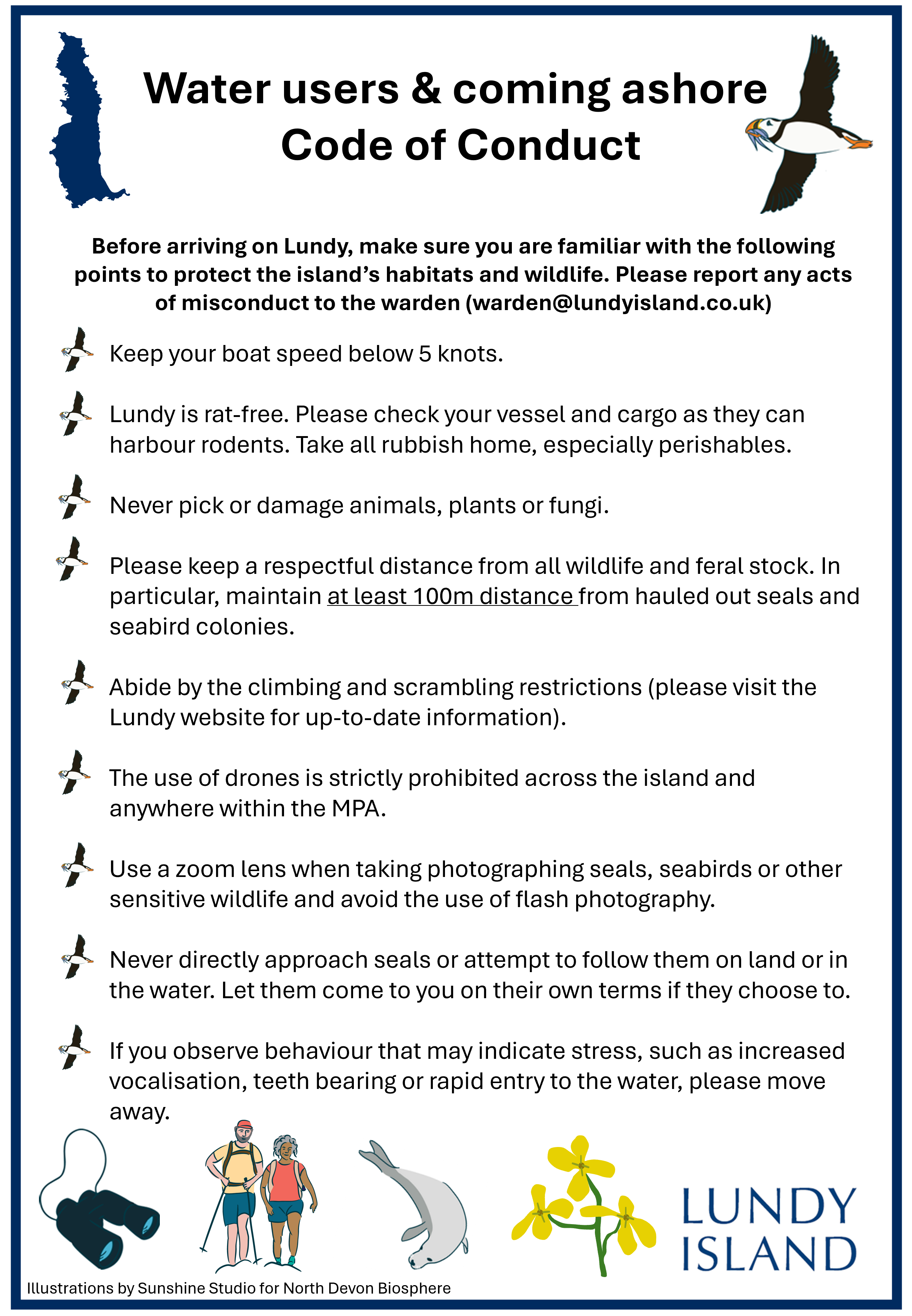
- Approaching seals on land, or going closer than 100m to where seals are hauled out
- Following seals or blocking their exit to the open sea
- Touching seals, or trying to get close to them with your face
- Bringing toys into the water to play with the seals
- Flash photography
NEVER get on a rock with a hauled out seal.
A seals behaviour may not be the same each day, you should closely observe a seals behaviour and if a seal appears to be threatened (showing behaviors such as crash diving, snorting and teeth bearing) people in the water should be informed of this and told to move away.
Distance from the shoreline
When watching seals from a boat, please stay at least 100m away from hauled out seals and keep noise to a minimum.