


Watch a short video about this exciting project.
Reading the room: the feminine symbolism of Lady Mary’s South Tower
March 2026
Landmark’s Historian Dr Caroline Stanford considers the messages concealed in Mary, 2nd Marchioness of Rockingham’s refurbishment of the South Tower in the late 1770s.
Mary, 2nd Marchioness of Rockingham, was a lively and intelligent woman, who was fortunate to be born into wealth and power, and to marry into more. She loved politics, horticulture, music, clothes – and interiors. Around 1778, having spent almost two decades helping her husband fit out the renowned State Rooms in his power house at Wentworth Woodhouse, she turned her attention to a more personal space.
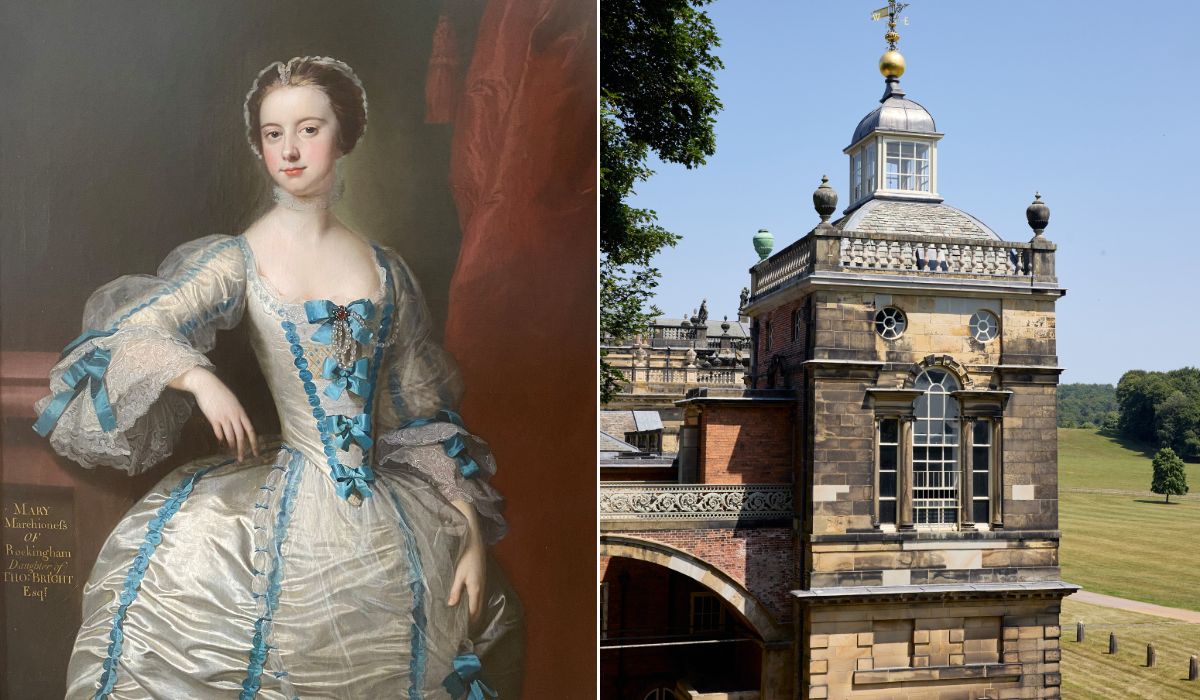
L: Mary, 2nd Marchioness of Rockingham. By kind permission of the Pennington Family of Muncaster Castle. R: The South Tower at Wentworth Woodhouse
She had her eye on the upper chamber of the South Tower. Up until now, this had been little more than a garden belvedere, possibly unheated and accessed only across a footbridge from the garden terrace. Lady Mary wished to turn it into her own private space, a light-filled place to write, read, entertain a few guests and gaze out across the mighty parkland.
She commissioned architect John Carr of York to manage the works, but hers was the overseeing mind, of every detail. She was busy shopping in London, for a white and yellow marble chimneypiece, for example, anxiously enquiring of Carr for the dimensions of the chimney breast to see if it would fit. And a few years earlier, the Rockinghams had acquired sets of plaster wall plaques that she also commandeered for the walls, and that still survive in situ.
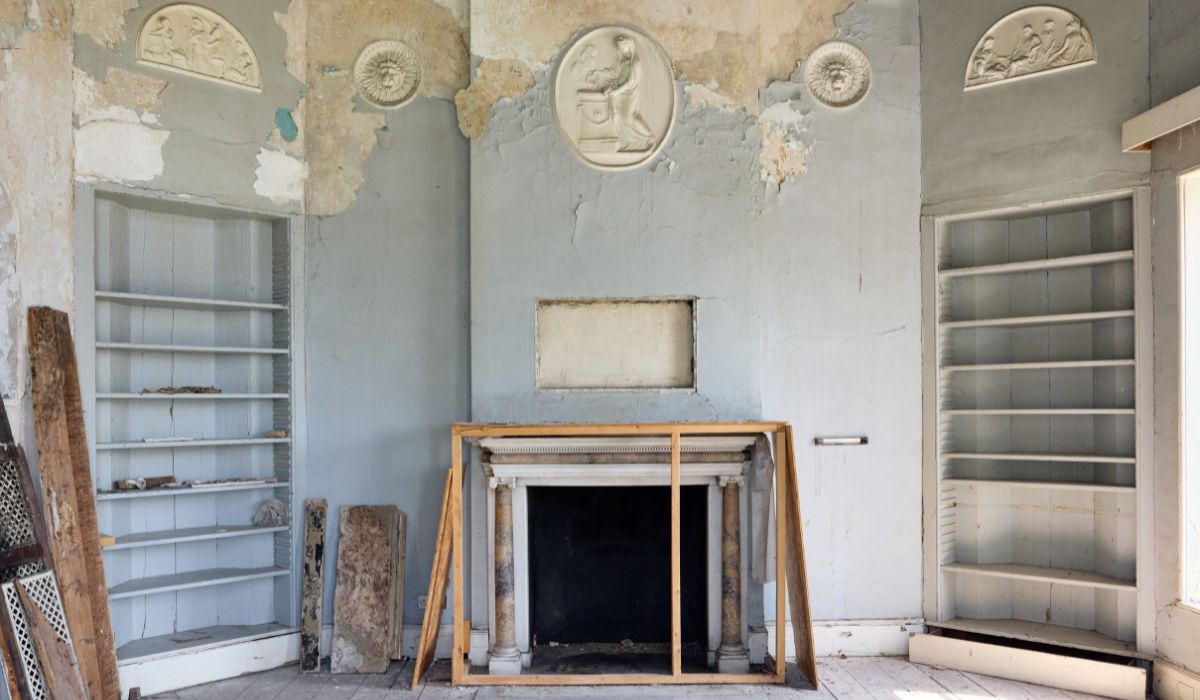
The interior of the South Tower in late 2025
These were the years when London was awash with mould makers and cast takers, all keen to profit from the seemingly inexhaustible appetite for the neoclassical. Such items could be bought from a catalogue, a saleroom or an auction house, their subjects typically inspired by widely available books of prints and engravings from those who had studied the originals in Italy.
We know from surviving Steward’s Accounts that the Rockinghams bought these plaques from the sculptor Joseph Wilton (who supplied plaster casts as well as original pieces) and from artificial stone manufacturer, George Davy. Davy supplied the four large lion rosettes and smaller, female faces that still dot the walls of the upper chamber in 1773. These, at least are fairly generic.
However, the other wall plaques, three ovals and four lunettes or ‘fan pieces’, all seem to have been carefully selected by the 2nd Marchioness for their feminine themes. Above the fireplace is an oval plaque of a female figure sacrificing at a classical altar, a popular depiction often identified as a vestal virgin. The other two ovals are nymphs personifying Winter (above the door) and Spring on the facing wall.
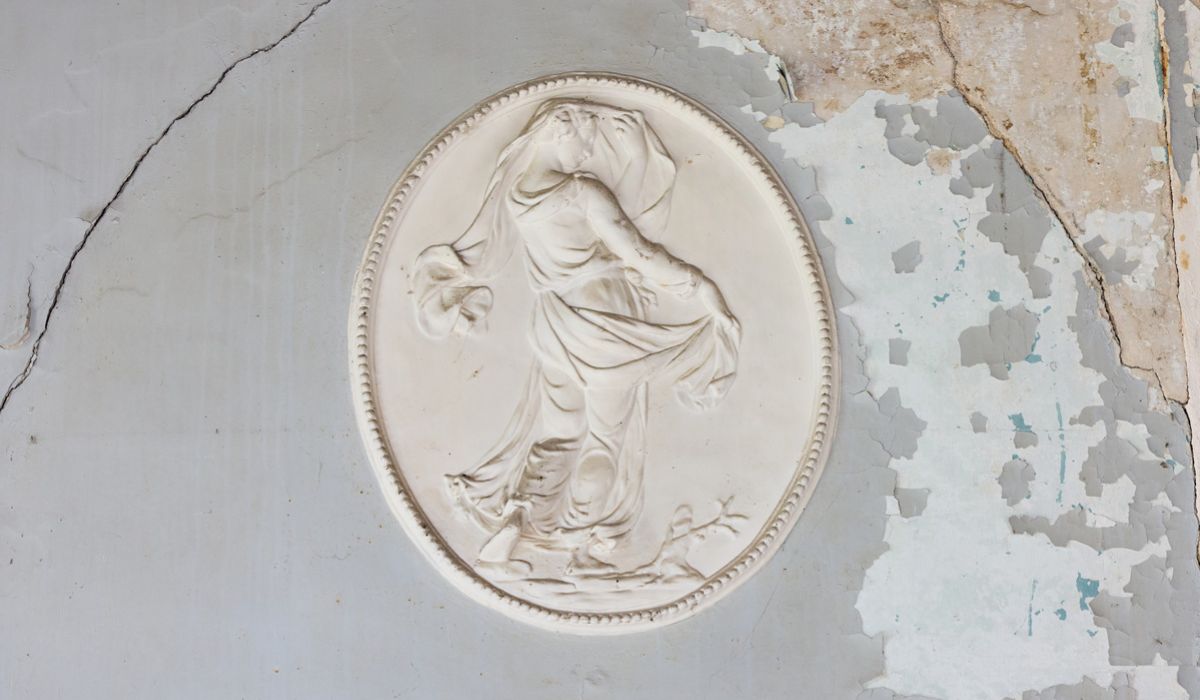
‘Winter’, above the entrance door, covering her head from the cold
The four lunettes are based on Bellori & Bartoli’s ‘Le pitture antiche del sepolcro de Nasonii nella Via Flaminia‘ (‘Ancient Paintings of the Tomb of the Nasonii on the Via Flaminia’). First published in 1680, its plates were widely distributed as engravings and were an important source of neoclassical inspiration. The Rockinghams bought a set of six such lunettes from Wilton, also in 1773. Only four were used in the South Tower, drawn from Plates VIII to XI. Women appear as central figures in all of them.
One (based on Plate X, below) depicts the fable of Alcestis, who died voluntarily to save her royal husband from his fated death. Hercules rescued her from the Underworld by wrestling with Death and here restores her to life before Jupiter and Minerva. Another (Plate VIII, below) shows Mercury and Demeter leading a young soul before Pluto, god of the Underworld and his wife Persephone.
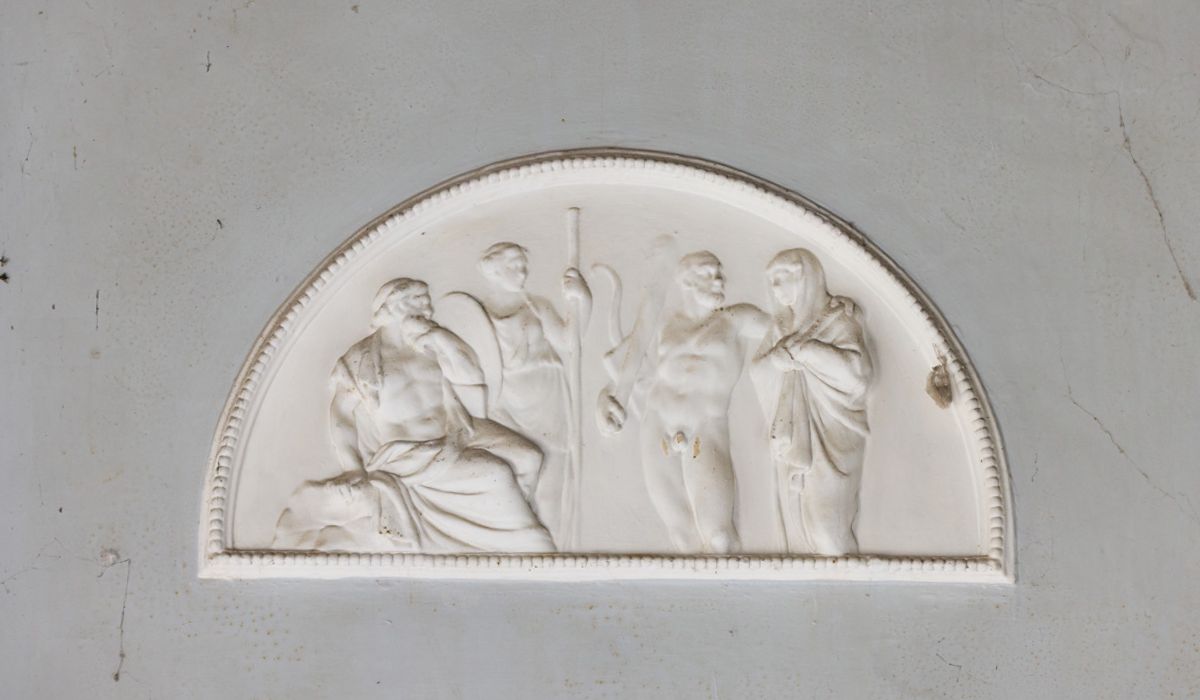
Loyal wife Alcestis, restored to life by Hercules.
However, the best piece of all is the superb marble plaque above the fireplace. This was carved by sculptor Joseph Nollekens, and it must have been a gift from Lady Mary’s husband. The 2nd Marquess had supported Nollekens’ career from its beginning. In 1762, the 25-year old Nollekens won a prize of 50 guineas from the Society of Arts for a plaque of this exact description, equivalent to some £5,000 today. It was enough to kickstart his training in Rome, where he remained for the next eight years. There seems no reason to doubt that this is the same plaque, acquired by Lord Rockingham.
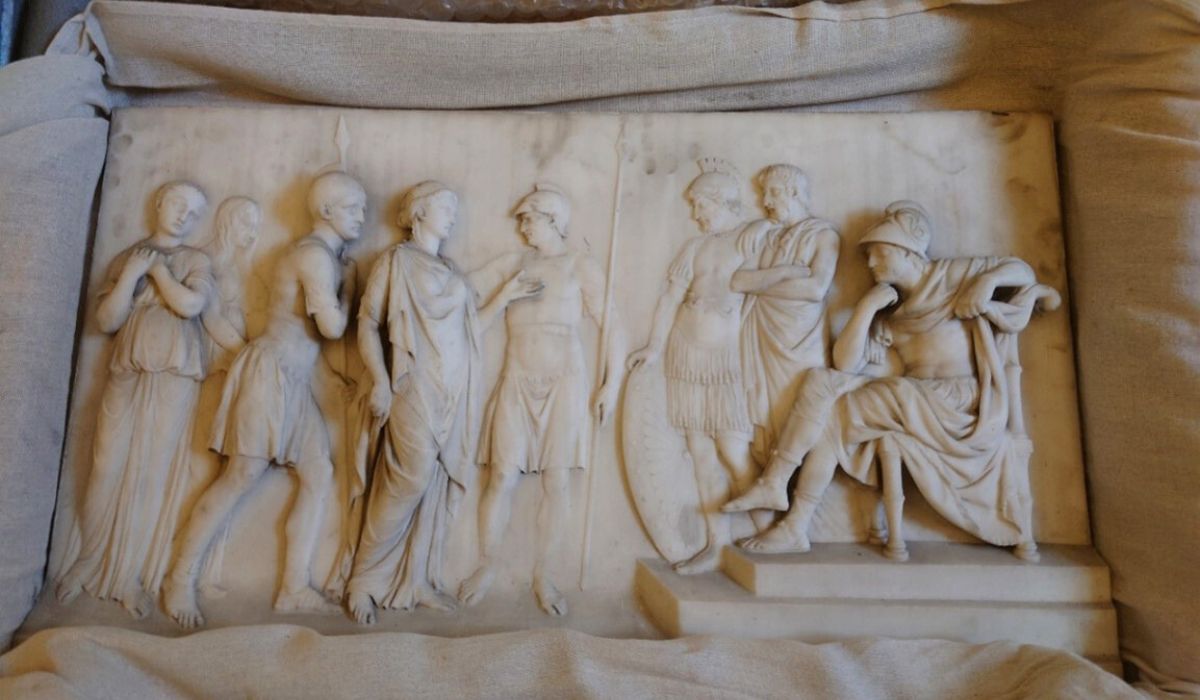
The Nollekens plaque: Timocleia brought before Alexander the Great
The scene depicted shows Timocleia brought before Alexander the Great. Timocleia was a Theban lady who was raped by one of Alexander’s captains when Thebes was sacked in 335 BCE. The captain then asked where her money was hidden. She led him into her garden, telling him the money was hidden in the well. When he stooped to look into the well, Timocleia pushed him into it, and then hurled down heavy stones until he died. Seized by his soldiers and brought before Alexander for her crime, she acted with such dignity that Alexander ordered Timocleia and her children be released without punishment. It is another tale of female agency and heroism.
Currently safe in storage, the Nollekens plaque will be returned to its original position as part of our restoration of the upper chamber.
These scenes are often opaque to us today, but to Lady Mary and her class, they were not just a fashionable decorative style but also fables they would recognise, conversation pieces that led to reflection on contemporary events and morals. Their survival makes the South Tower still more precious, as the rare and concrete expression of the taste and education of a Georgian Marchioness, decorating a room for herself.
How exciting that the evidence remains for us to recreate it in our latest project.
Read more about our plans for the South Tower and support our fundraising appeal for the restoration.
