
-

0 -

No fire or stove -

No dogs -

No or weak mobile signal -

Overview
Wentworth Woodhouse is one of the largest and most famous 18th century houses in England
This Palladian mansion near Rotherham in South Yorkshire is set in an equally important landscape, today reinstated after open-cast mining in the mid-20th century. Built by the 1st and 2nd Marquesses of Rockingham from 1730, the opulent exterior was matched by grand interiors and contents.
Working in partnership with the Wentworth Woodhouse Preservation Trust (WWPT), who are restoring this large and important site, we hope to create a Landmark for two in the South Tower of the East Front.

With a private entrance and easy access to the spectacular grounds, this secluded eyrie in one of England’s most notable houses will, we hope, become a truly elegant place to stay
Around 1773, this upper chamber was adopted by his eventual wife Mary, 2nd Marchioness of Rockingham, as her parlour. It was likely she who instructed that it be decorated with fine plasterwork and wall plaques on Classical themes. This makes the space an important survival of feminine taste in the Georgian period.
In the 1790s, an internal access to the upper chamber was created when an additional storey was added to the east wing, by the architect John Carr. The rooms adjoining the parlour became service and servant rooms and much later, from the 1950s, were used for the female students of the Lady Mabel College of Physical Education, which later merged with Sheffield Polytechnic.
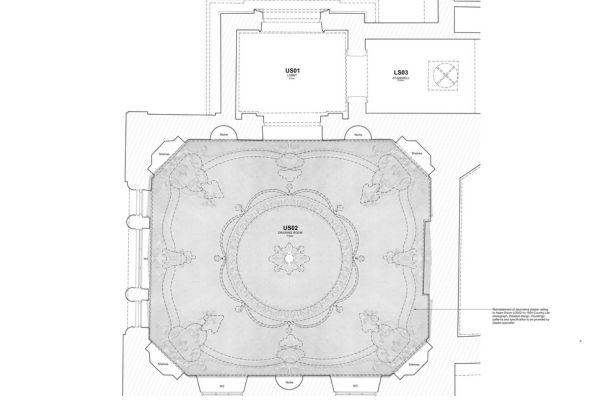
While the outside of the South Tower has been fully and admirably restored to its 18th Century appearance by the Wentworth House Preservation Trust, the condition of its once-opulent interior is in urgent need. The decorative ceiling has already been lost but we have a photo taken in 1924 that will enable us to recreate it. Fine plasterwork is crumbling but the marble chimneypiece has survived. So too has a marble plaque by sculptor Jospeh Nollekens, which is now in storage in safe storage awaiting reinstatement. Some of the wall plaques are by a little known manufacturer of fired artificial stone called George Davy, who predates Mrs Coade. Paint analysis will enable us to recreate Lady Rockingham’s original colours.
This restoration is important work that will require the most skilled of craftspeople
Detailed building analysis has been done, and rich documentary research is ongoing. With your support, we are confident that we can restore Lady Rockingham’s parlour to its former elegance as a sitting room 1780. Kitchen, bathroom and bedroom will be in the adjoining top floor. The bedroom, in the curved Quadrant that links wing to tower, has a spectacular view along one of the most important facades in the country, longer even than Buckingham Palace.
If you can help lay the crucial foundations of this project with a gift of £6,000 or more, becoming a Guardian of the South Tower, we would love to hear from you. Please contact Bruce Hall (bhall@landmark trust.org.uk) or Hatty Masser ([email protected]) for more information.


History
Within a house of power and pomp, sits a chamber of exquisite elegance
Wentworth Woodhouse is the creation of the 1st and 2nd Marquesses of Rockingham. Its vast main frontage, built in the Palladian style, is longer even than Buckingham Palace. The 1st Marquess completed the structure by 1748 as a seat of regional and national power. Charles Wentworth-Watson, 2nd Marquess, who was twice Prime Minister and instrumental in American independence, then set to work on its stunningly opulent interiors.
The Fitzwilliam family inherited the house from the 2nd Marquess following his death in 1782. Nationalisation of the coal industry in 1946 saw Wentworth Woodhouse’s lovely parkland requisitioned for open-cast mining, and in 1950, the mansion was leased to become the Lady Mabel College of Physical Education. By 1989, the whole site was in a state of advancing decay.
A brave private attempt at rescue followed but came to nothing. In 2014, after a campaign spearheaded by SAVE Britain’s Heritage, the derelict mansion was bought by the Wentworth Woodhouse Preservation Trust (WWPT) who have embarked on the herculean task of restoring the place back to its former glory, a multi-phase project that will take years to complete.


The South Tower
The South Tower is a jewel within this mighty setting. Its external design is most likely the work of Henry Flitcroft, one of several architects employed by the Rockinghams.
In 1752, the 2nd Marquess married Mary Bright, a lively and intelligent Yorkshire heiress. In the mid-1770s Mary requested the South Tower chamber as her private parlour, as a place where she could entertain friends or simply enjoy some peace and privacy.
An interior of supreme importance
Our project will recreate the 2nd Marchioness’s scheme, on which she worked closely with architect John Carr. Vouchers show that the plaques that still adorn the walls were ordered from London suppliers Joseph Wilton and George Davy. They reflect feminine taste: tales of heroic women in classical times and graceful nymphs personifying the seasons.
The 2nd Marquess sponsored the training in Rome of the great sculptor Joseph Nollekens. A superb marble panel was inset above the fireplace, and is currently in safe storage pending its reinstatement.
We know the contents of the room at the 2nd Marquess's death from a 1782 inventory. It mentions a ‘Patent Stove … 2 Sopha’s stuffed with Straw … a Kitterminster Carpet to cover the Floor…5 Spring Blinds of Brown Holland’. This will help guide our furnishing decisions.
The parlour chamber was originally accessed only from outside, across an ornate footbridge. In the 1790s, Carr added an extra floor to the south wing, creating internal access to the South Tower chamber for the first time. By 1819, we know from tradesmen’s invoices that the parlour had become the Fitzwilliam heir, Lord Milton’s, study. The top floor of the curved block linking tower and wing (the Quadrant) was now the governess’s bedroom, with adjacent washing facilities.
The South Tower’s exterior, complete with gilded finial and working wind vane, was beautifully restored by the WWPT in 2022 and is now sound.
With your support we can ensure the survival and revival of this unique part of the Wentworth Woodhouse story.
Our plans
Like the 2nd Marquess and Marchioness, we will require the finest craftspeople and materials to recreate the glory of the South Tower.
We have worked out the details of a scheme to take on a long lease from the WWPT to make a Landmark for two in the South Tower
An 1832 floorplan shows the parlour when it was Lord Milton’s, study. The curved block linking tower and wing (the Quadrant) was now the governess’s bedroom, with adjacent washing facilities.
In our plans, the parlour would become the drawing and dining room, and a bedroom, kitchen and bathroom would be created in the adjacent rooms. The approach would be via a handsome private footbridge from the elevated rear terrace, as it was from the first.
-

Current floorplan
-

Proposed floorplan
-

1832 floorplan
Recreating the Marchioness’s parlour
We plan to recreate the decorative finishes of the upper chamber to as they were when Mary, 2nd Marchioness made it her own in the 1770s. Detailed paint analysis has revealed she chose a deep teal blue for the walls, a fashionable paint colour at the time.
We would use traditional 18th-century techniques to re-create the Marchioness’s lost ceiling of decorative plasterwork, guided by a single surviving historic photograph, and to draw on the inventory to furnish her elegant chamber to evoke its character in its prime.
Sustainability
In line with Landmark’s commitment to use only non-fossil fuel energy sources in future restorations, heating and hot water will be delivered via an Air Source Heat Pump sited on the adjacent roof, to feed underfloor heating in the upper chamber and cast-iron radiators in the other rooms.
The large windows in the upper chamber will be given slimline heritage glazing with draught-pile brushes to ensure draught-proofing. The glass will be solar glazed to reduce glare and fading.