

Inspiring women and the buildings they left behind
Women’s History Month celebrates the often overlooked achievements of women throughout history. We’ve picked five women who were instrumental in the creation or continuation of some of our buildings – and who made a significant contribution to architectural history and the arts.
Margaret, Countess of Cumberland (1560-1616) & Lady Anne Clifford (1590-1676)
Margaret Russell was the daughter of the second Earl of Bedford. Brought up in Northampton and at Woburn, she married George Clifford, third Earl of Cumberland at the age of seventeen. Head of a great northern family, his seat was at Skipton Castle in the West Riding of Yorkshire.
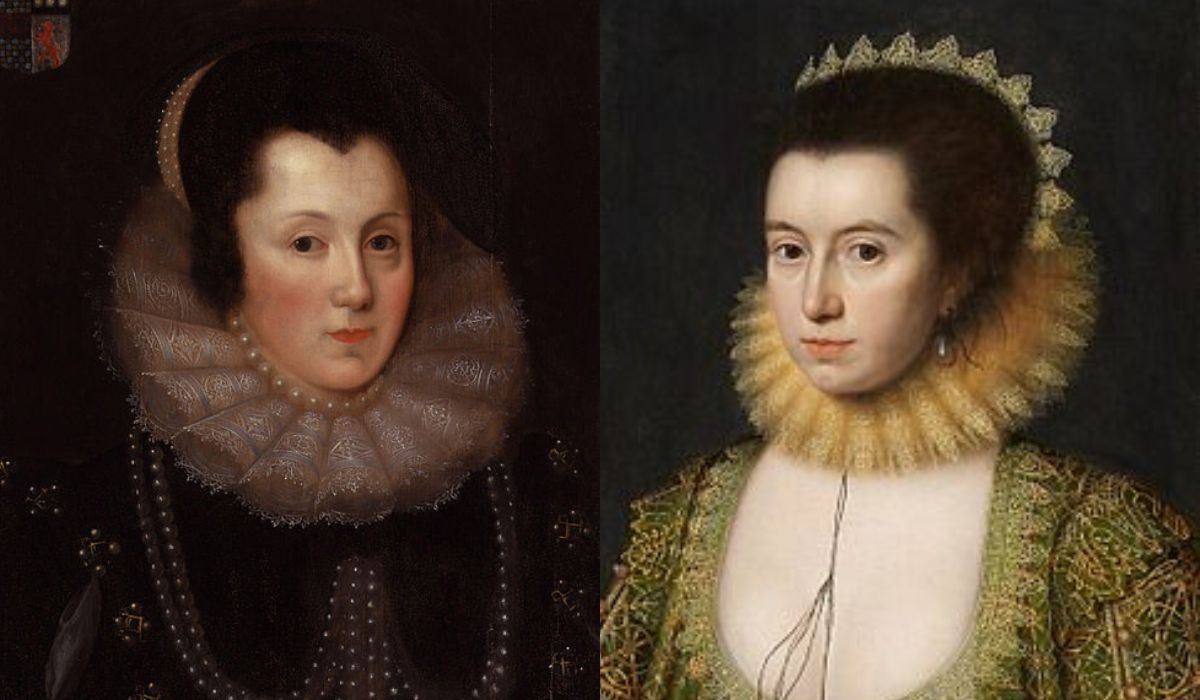 Margaret, Countess of Cumberland (left) and her daughter Lady Anne Clifford (right). Images: National Portrait Gallery
Highly intelligent, pious and a keen amateur chemist, Margaret was very different from her buccaneering husband. She was often alone as she bore three children of whom only one survived, a daughter, Anne, born at Skipton Castle in 1590.
Three years after Anne’s birth the countess founded Beamsley Hospital, an almshouse for the poor women of Skipton, those decrepit and broken by age, who were reduced to daily begging. The hospital’s income was to come from farmlands provided by the Countess. The Earl and Countess separated in 1600, and on her death in 1616, she left the Beamsley almshouse incomplete, but stipulated in her will that “the almshouse which I have taken order for may be perfected”.
The task of completing the project was taken on by her daughter, Lady Anne Clifford, who added an additional building, enabling the foundation to accommodate thirteen women – a “mother” and twelve “sisters” (a common number of residents in an almshouse, echoing the number of Christ and his Apostles).
Circumstances had made both the Countess and Lady Anne into resilient, independent women. After Margaret’s separation from the Earl of Cumberland, she fought a long and bitter battle, continued by her daughter, to try to regain Anne’s inheritance from her male cousins. Mother and daughter had become devoted to one another. When Margaret died, Anne built a magnificent tomb to her in the parish church at Appleby, Cumbria.
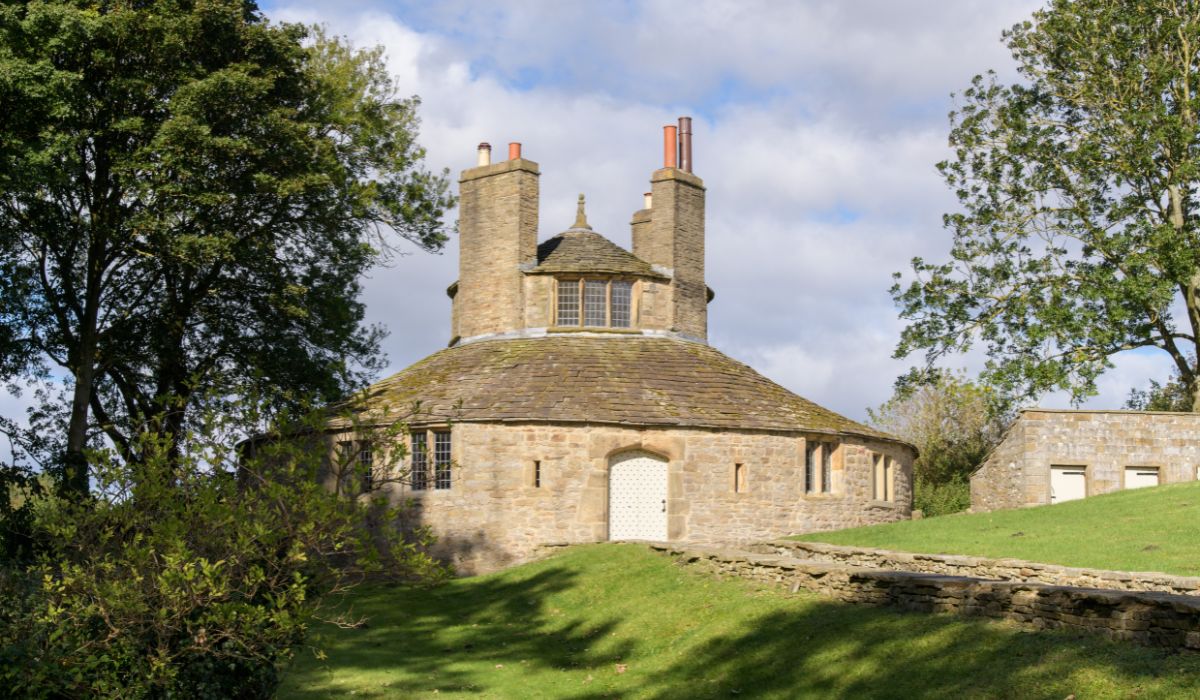 The circular Beamsley Hospital in Skipton
Lady Anne kept active after her mother’s death. Between 1652 and 1662 she repaired her castles Appleby, Brougham, Brough, Skipton, and Pendragon, which was burnt down by the Scots. She founded more almshouses at Appleby which, like Beamsley, were for poor women. She paid attention to every detail of the running of her estate. She could be a hard landlord, but there is a touching story of her insisting on a tenant giving her a chicken was part of his rent, and when he reluctantly did so, asking him to dine with her and eat it.
At Beamsley, mother and daughter created an environment in which widowed women could live independently, and it was a place Anne cherished, calling it “my blessed mother’s almshouse at Beamsley."
This is an extract from 'Landmark: A History of Britain in 50 Buildings' by Anna Keay and Caroline Stanford
Mary Watson-Wentworth, Marchioness of Rockingham (c.1735–1804)
Mary Bright, later Mary Watson-Wentworth, Marchioness of Rockingham, was a Yorkshire heiress whose influence extended subtly but decisively into the political life of 18th-century Britain.
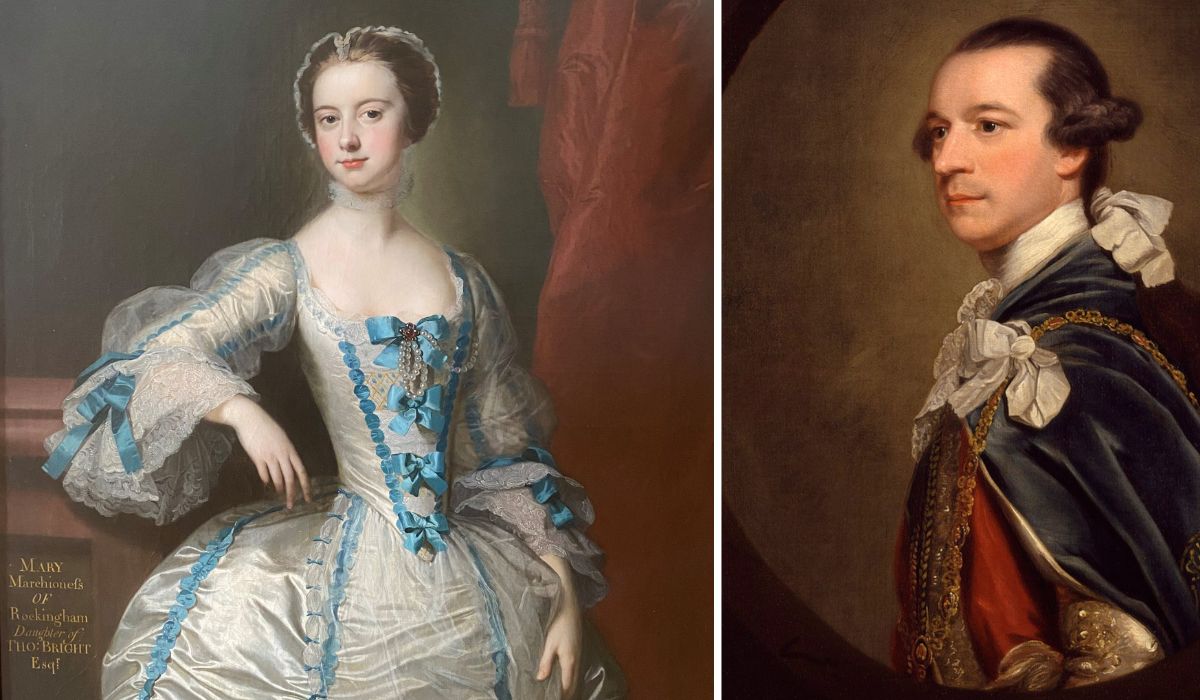
Mary Watson-Wentworth, 2nd Marchioness of Rockingham (left) and her husband Charles, the 2nd Marquess (right). Image: Muncaster Castle
Born in Pontefract and baptised at Ackworth on 27 August 1735, she was the only child of Thomas Liddell, Lord of the Manor of Ecclesall, and Margaret Norton. Her father later adopted the surname Bright after inheriting Badsworth Hall from his grandfather John Bright. As the family’s sole heir, Mary brought considerable wealth and status to her marriage in February 1752 to the Whig politician Charles Watson-Wentworth, the 2nd Marquess of Rockingham. The pair corresponded constantly throughout the 30 years of their marriage, and their many surviving letters reveal a close intellectual partnership.
Contemporaries recognised Mary as more than a political spouse. She described herself, half-jokingly, as her husband’s 'secretary', yet letters from the period show that allies and opponents alike often wrote to her directly about political matters. Rockingham himself referred to her as 'my Minerva at my elbow', an acknowledgement of the advice she offered during his career, including his two terms as Prime Minister. After Rockingham’s death, the statesman Edmund Burke wrote to her that their names 'ought to go down together', noting the part she had played in the public service associated with his ministry. Her letters demonstrate her involvement in the political networks of the Whig party and in the management of her husband’s affairs.
Mary was also an active patron of the arts and architecture, with exceptional taste in design. In the mid-1770s she oversaw improvements to the South Tower at the Rockingham's vast country estate, Wentworth Woodhouse, working closely with the York architect John Carr. Under her direction the chamber there was completed with a marble chimneypiece, a decorative ceiling and oval plaster reliefs of classical subjects. Vouchers record that the wall plaques were ordered from the London suppliers Joseph Wilton and George Davy, depicting heroic women of antiquity and allegorical figures of the seasons - a decorative scheme that reflected both classical learning and contemporary feminine taste. The South Tower chamber served as Lady Rockingham’s private parlour, a space where she could conduct correspondence, receive friends or withdraw from the formal routines of the house.
Sadly, Wentworth Woodhouse fell into disrepar in the years that followed, and the South Tower now sits empty and forgotten, its rich interiors crumbling and its finely decorated ceiling lost to water ingress. We hope to restore the parlour back to its 18th-century finery and create a Landmark for two by 2027, if we can raise the necessary funds for the works.
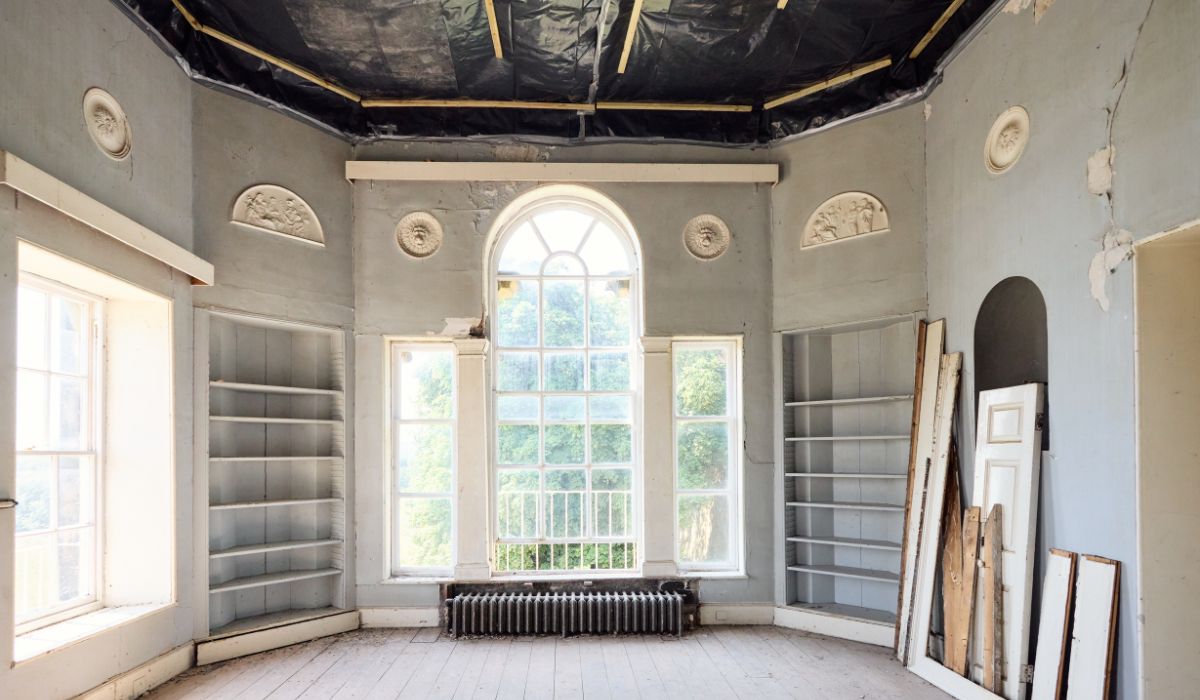
Inside Mary's now sadly dilapidated parlour in the South Tower at Wentworth Woodhouse, which we hope to restore into a new Landmark by 2027
As a widow, Lady Rockingham settled at Hillingdon House in Middlesex in 1785. She died in 1804 and was buried beside her husband in York Minster, leaving behind a legacy of not only political partnership but thoughtful patronage and domestic influence within one of the leading Whig households of the 18th century.
Support our restoration of the South Tower
Mary Delany (1700-1788)
The 18th-century Bath House near Stratford-upon-Avon was built for Sir Charles Mordaunt of Walton Hall and designed by Sanderson Miller. The basement contains a magnificent plunge pool, but it is Mary Delany’s lavish shell festoons in the main room that make the building special. Shell collecting was a fashionable pastime for 18th-century women and some of them created wonderfully intricate grottoes. Very few women, however, possessed the virtuosity of Mary Delany who was famed for her shell collection and decorative powers.
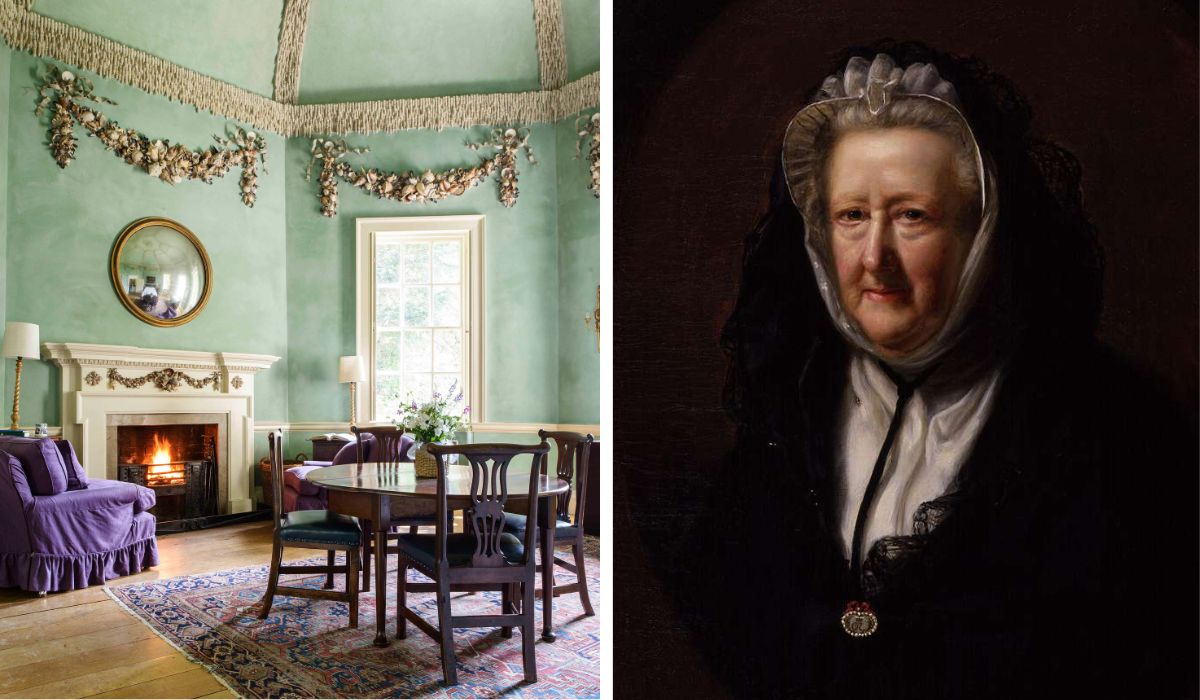
L: The main room at the Bath House. The ceiling and walls are festooned with shells collected by Mary Delany. R: Mary Delany in later life IImage: Royal Collection)
Mrs Delany was an artist who is most famous or her paper flower pictures. She was born in 1700 into court circles: her father’s older brother was created Lord Lansdowne by Queen Anne and her aunt was a Maid of Honour to Queen Mary. At the age of 17, to her horror, her uncle arranged for her to marry Alexander Pendarves of Roscrow, Cornwall. In her memoirs, Mrs Delany wrote: “I was married with great pomp. Never was woe drest out in gayer colours, and when I was led to the altar, I wished from my soul I had been led, as Iphigenia was, to be sacrificed”
Mrs Delany was widowed at the age of 23. She became interested in shells whilst staying in Ireland and writes from the seat of the Bishop of Killala in County Mayo in 1732 that she was busy gathering shells for a grotto. By 1734 she had quite a collection, proudly displaying them in a cabinet at her house in Lower Brook Street. “I have got a new madness, I am running wild after shells” she wrote in a letter. “The beauties of shells are as infinite as of flowers…”
After a second marriage to Rev. Patrick Delany, she met Sir Charles Mordaunt and Sanderson Miller. It was perhaps Miller’s suggestion that Delany would choose the shells to decorate the main room in Mordaunt’s Bath House.
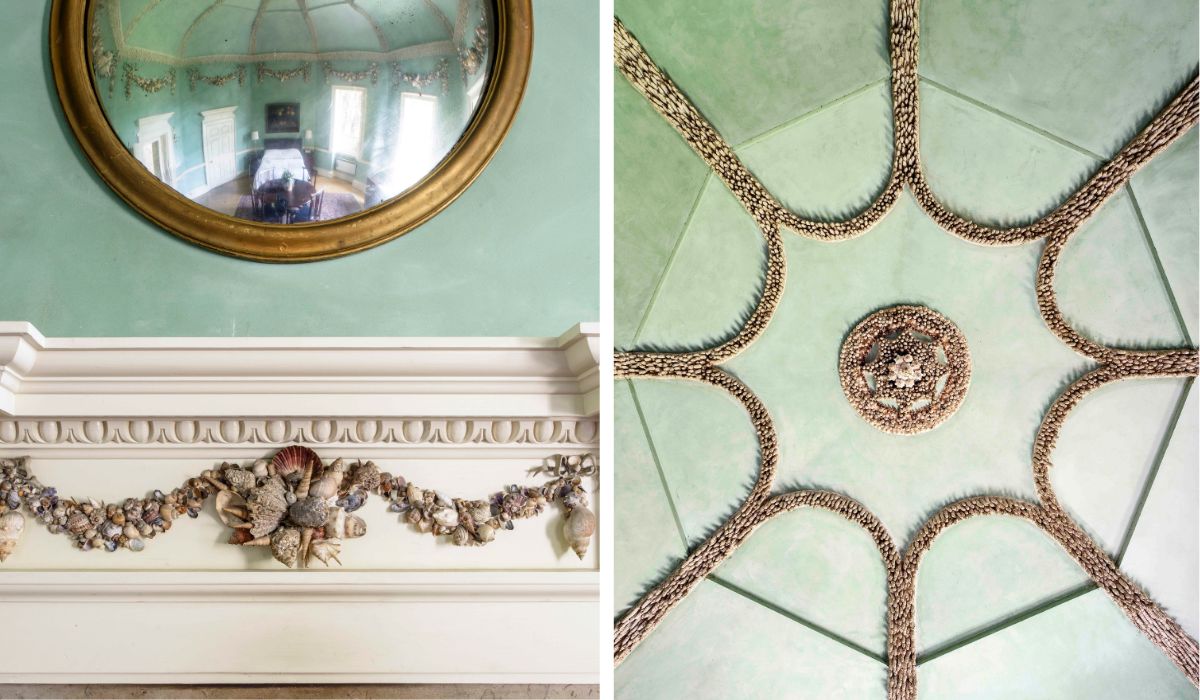
Details from the fireplace and ceiling at the Bath House, decorated in Mary's shells
Procuring shells – scallops, conches, giant clams – was not always easy. Foreign shells were expensive and Mrs Delany frequently made expeditions to the sea shore. She often asked sea captains who were sailing to distant parts to bring her back barrels of shells. She collected some from the West Indies, Naples and the Channel Islands.
Her letters to her sister in July 1754 suggest that she was experiencing problems with obtaining the right shells. “I have not yet got shells large enough for the festoons and fear it will be in vain to make them here” she wrote. However, after what must have been a busy few months, Mrs Delany reported that the shells had arrived at the Bath House by November.
From her letters, it is clear that Mary Delany was closely involved in directing the design of the festoons at the Bath House. Whether she took part in the work herself is not clear, but it is hard to believe that such a lively and accomplished end result was achieved without her.
Eleanor Coade (1733-1821)
Eleanor Coade became a unique figure in architectural history by managing a hugely successful artificial stone manufactory in Lambeth in the ‘man’s world’ of the Georgian era. Eleanor ran her business not as a wife or a widow – like other Georgian business women – but in her own right. Her Coade stone was used upon many Regency buildings across Britain and can still be found on buildings like the Royal Naval College in Greenwich, Buckingham Palace and Belmont, a seaside villa in Lyme Regis that Mrs Coade owned for nearly 50 years. Coade stone still adorns the beautiful exterior of Belmont today in the form of sea creatures, quoins and series of urns along the parapet.
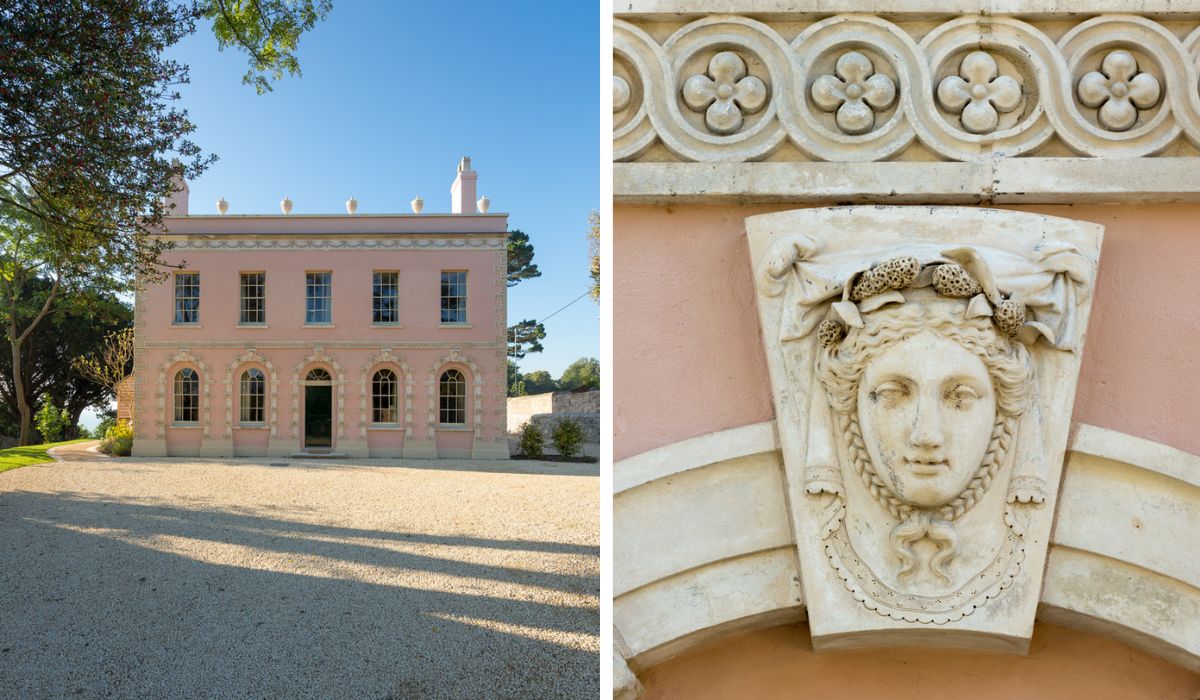 Durable Coade stone on the exterior of Belmont in Lyme Regis
Men had been searching for an effective artificial stone for decades. London was expanding apace in the 18th century and it was here that opportunity lay, as a groundswell of aesthetic discontent with the appearance of these new streets emerged. What was needed was a ready supply of wares of consistent quality and dimension that architects could plan into their designs from the start. The success of Coade stone therefore made it possible for architects to exploit, develop and include the infinite variety of the classical vocabulary of ornament in a way that reliance on natural stone would have rendered impractical.
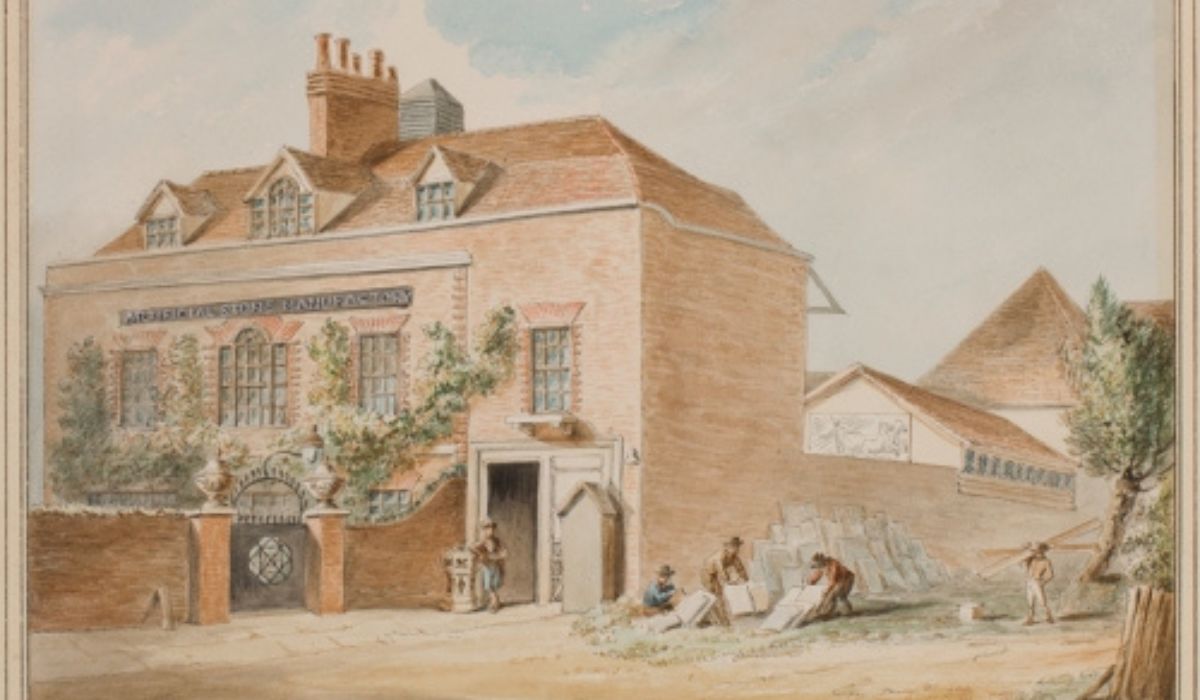 Coade's Artificial Stone Manufactory in Lambeth, 1802. The door leads to a show room (Image: London Metropolitan Archives, City of London)
Along with her mother, Eleanor Coade took on a failing artificial stone manufactory in Lambeth in 1769, sacking the previous manager Daniel Pincot. Why was Coade stone so successful? Artificial stone was not a new idea: Pincot had been preceded in Lambeth by Richard Holt, who in 1730 wrote the obscure A Short Treatise of Artificial Stone. What makes Coade stone different from most of the artificial stone made either before or since is that it was created by firing – rather than by the casting of a cement compound. A cast formula relies on chemical reaction for its hardness. By contrast, Coade stone derives its hardness from firing, and is, essentially, a ceramic or stoneware.
There was criticism of Coade stone ("nature is better than art") but Mrs Coade countered this with a catalogue showcasing nearly 800 stone designs, highlighting how pieces could be customised: a goddess’s face given different headdresses, columns and capitals mixed and matched, chimneypieces assembled by assortment. Great architects of the day, including James Wyatt and Jeffry Wyatville, found this positioning convincing and incorporated Coade stone in their designs and interiors. Its fame spread and it was shipped worldwide from St Petersburg to the Caribbean.
Eleanor Coade died aged 88 on 18 November. Her will tells us that she was pious and charitable, leaving bequests to be distributed by eight Baptist ministers. Where she left money to married women, it was often in the form of trusts “for their separate use” so that it would not form part of their husbands’ estate, a century before the Married Women’s Property Act.
Artificial stone continued, but the genre divided into more mass-produced cold cast cements and explicitly terracotta wares that had no stock with the refined Coade formulations and process. The Coade stone process did not long survive the forceful woman who made it so characteristic of the architecture and landscapes of the 18th century – perhaps it was too skilled a process for the increasingly mechanisation of the Victorian Age. Eleanor Coade’s legacy lives on in buildings across the country (and beyond), yet today she is scarcely known beyond architectural historians. Landmark’s work at Belmont revives her memory and achievements.


