

The renaissance of Laughton Place
An exciting, once-in-a-generation refurbishment of Laughton Place is underway, including the careful conservation of its Tudor terracotta. Landmark’s Historian, Caroline Stanford, explains more.
Landmark’s much-loved tower at Laughton Place is all that remains of a once-great seat of power, dating back to the 13th century. Laughton Place also has a secret glory. It is decorated inside and out with exceptionally fine early terracotta embellishment.
Today, the tower stands proudly isolated in the plain behind the East Sussex Downs near Lewes. The Downs are not enough to protect it from weather sweeping in from the sea, however, and the manor house was once moated, making the most of its marshy plot. The tower has probably always suffered from damp penetration, and solving this has been the main reason for the major repair and refurbishment works currently underway there.
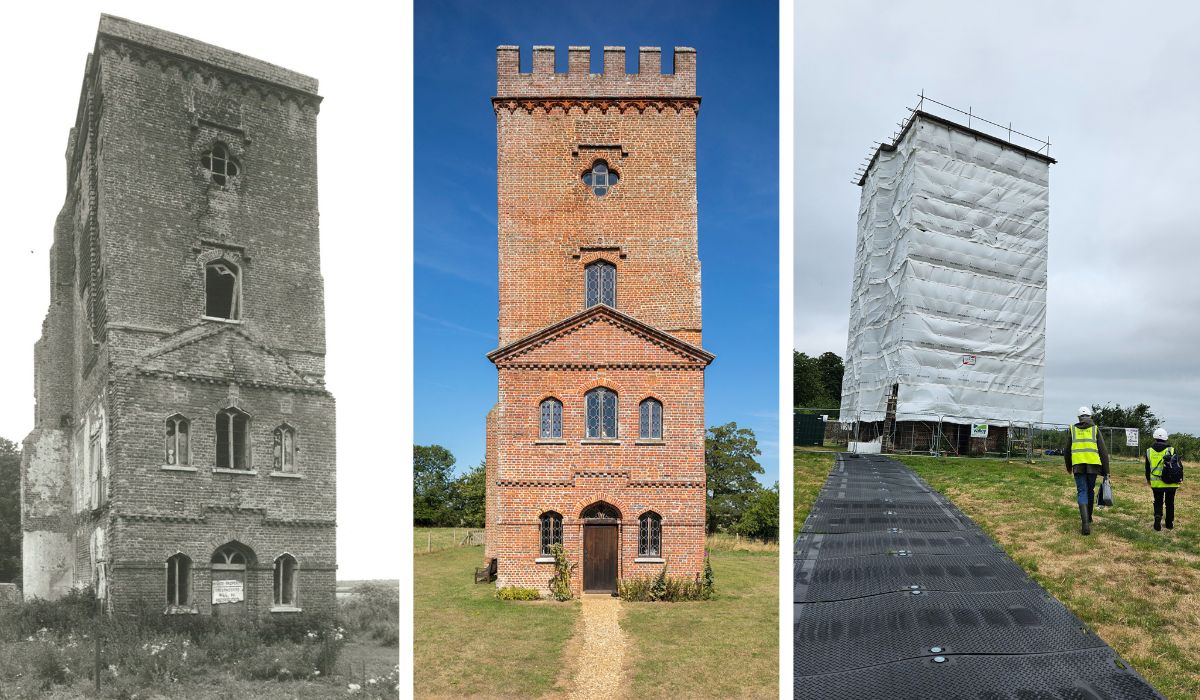
Laughton Place in 1978, 2018 and 2025.
Graceful arabesques captured in terracotta
The tower’s construction can be dated to 1534, when Sir William Pelham (1468-1538) of ancient Laughton lineage made significant improvements to his family seat. – ‘Ian de grace 1534 fut cest mayso faicte’ (‘This house was built in the year of grace 1534’).
Sir William’s generation embraced fully the influence of the Continental Renaissance ideas, before the break with Rome in the 1530s turned England in on itself. Foremost in design terms were the graceful arabesques and grotesque work fashionable in the French and Italian courts, brought to England in the 1510s and 20s by Italian craftsmen employed by the king and his courtiers. Indeed, Laughton’s terracotta provided valuable context for our discovery of the 16th-century wall paintings at Calverley Old Hall in 2021.
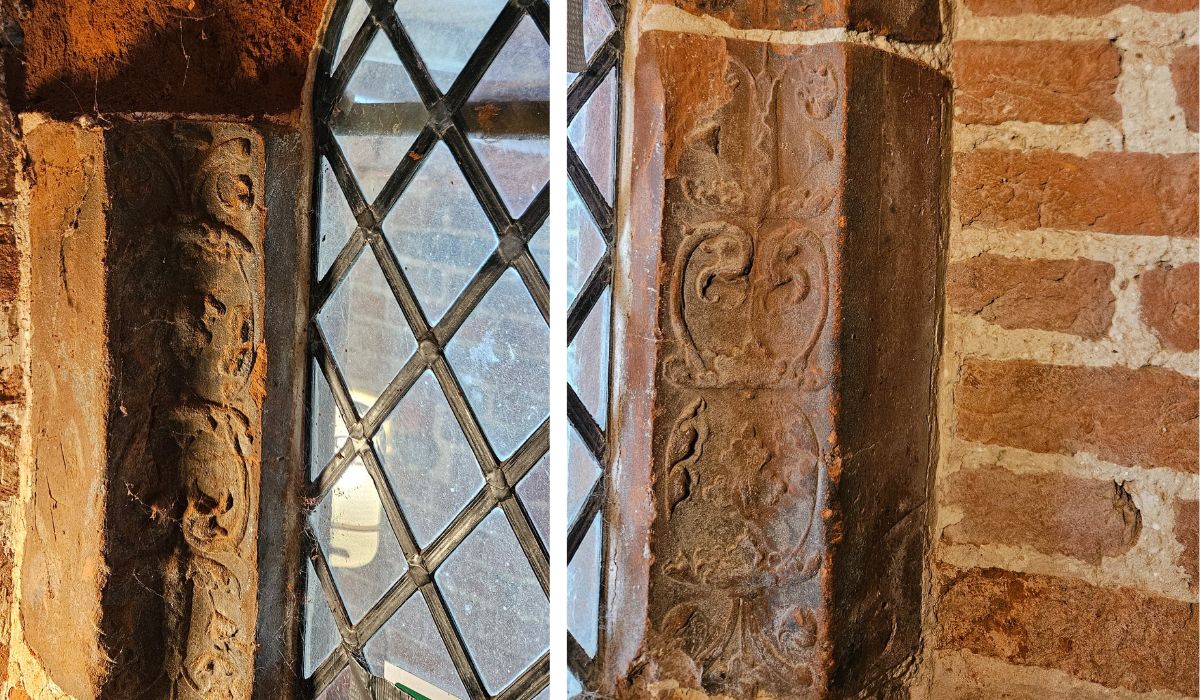
Detail of the decorative terracotta on the frame of a ground floor window. The detail needs cleaning and consolidation to prevent further degradation but is still astonishingly crisp after five centuries.
It is not surprising, then, that Sir William chose to decorate his tower not just with his family emblem, the Pelham Buckle, but also with elegantly moulded terracotta arabesques and candelabras of almost impossible fineness in the Renaissance style, around windows and even on the main fabric of the tower. What is surprising is that, even in this exposed position, so much of the terracotta has survived, now a rare and precious treasure.

The Pelham Buckle between two stylised beasts’ heads.
When Landmark first repaired the decaying tower in the early 1980s, the terracotta had, in places, fractured badly. The pieces were reunited then by inserting glass fibre dowels, filling any gaps with resin coloured with brick dust. Missing sections, such as a sill or the head of a window, were renewed but left plain.

By 2025, this internal window spandrel had decayed entirely. Replacement will be the only option here.
2025: a chance for a closer look
In 2025, the tower was completely scaffolded and sheeted for the raking out of all the joints, ready for the eventual re-pointing of the early Tudor brickwork from top to bottom. This painstaking task is being carried out by our main contractor, Valley Builders of East Grinstead, often in sweltering conditions under the sheeting.
The full-height scaffolding also provides the chance for renewed analysis and conservation of the external terracotta, fifty years after the initial restoration. Terracotta specialist Catherine Wollfitt has been advising us, who brings experience of working on the conservation of the contemporary terracotta roundels at Hampton Court Palace.
Much of the Laughton terracotta is scattered with tiny surface cracks, some no doubt ‘firing cracks’ from minor shrinkage in the kiln, others from general stresses and inevitable gentle decay. Micro-organic growth and insect debris can make these fractures difficult to assess, but where they extend through the full thickness of the block and there is a risk of detachment, new pinning and grouting will be needed.
The scaffolding allows detailed scrutiny of the decorative ‘corbel table’ at parapet level, and we’ve adjusted the scaffold design to allow for full access to this. The table is a cornice of more substantial moulded terracotta elements, formed of linked cinquefoil (five-cusped) arches on brackets. Its overhang implies a structural function, as if providing jettied support to the crenelations. In fact, the arches are not very thick and purely decorative; we now need to investigate their fixings.

The corbel table
Sitting above the arches is a narrow decorative band of arabesque terracotta. The band is echoed in terracotta drip moulds to the windows below.

The corbel table. Hairline fractures are visible in the surface of the lower decorative moulding. Joints are eroding and lichen and staining are starting to obscure its detail.
Most of the tower’s window frames are also made of terracotta, and it is here that we can appreciate the Tudor craftsmanship most fully.
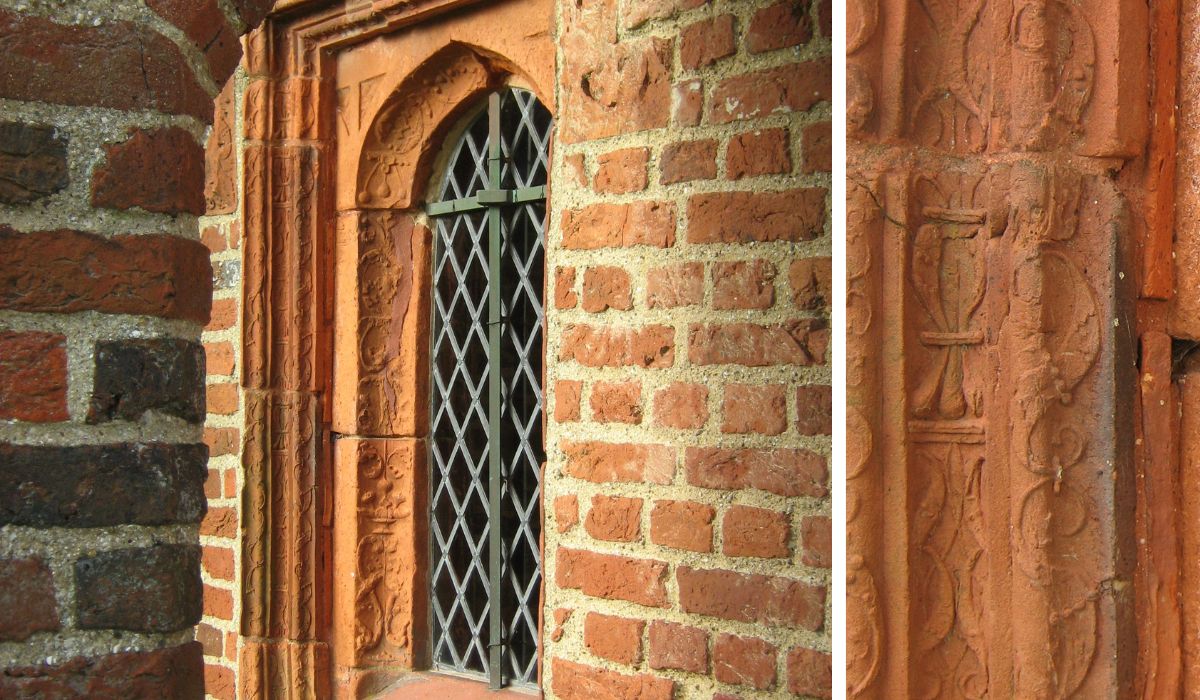
Ground floor window. The sill is a 1970s replacement.
Weighing up our approach to repair
Before we can settle on the detail of our repair approach, all the terracotta will need to be cleaned of surface soiling. A variety of methods will be used including dry brushing with soft brushes, gentle vacuuming and perhaps wet cleaning with a small steam cleaner for more stubborn areas. The presence of past repairs will be recorded, and later the repairs carried out in this current phase. Replacement will only be considered as a last resort.
The corbel band will also be checked for any embedded iron or other fixings with a handheld metal detector. Designing our repair approach will be especially challenging given the exposed situation of the corbel table. One idea is for a protective lead cover chased into the brickwork above the terracotta band and bedded onto a mortar flaunching. Another option is a lime-based sheltercoat, which would prevent rainwater being trapped in the surface cracks and discourage the recurrence of organic growth. This is a less intrusive approach, but would require more maintenance. Such are the pros and cons that have to be carefully weighed in any building conservation work.
We’re also taking the chance to think again about the room configuration – so watch this space for further updates on this exciting, once-in-a-generation refurbishment of theTudor tower. You can read more about the history of Laughton Place here.
With thanks to Landmark’s supporters
To carry out major refurbishments like this one, we increasingly rely upon unrestricted income from legacies, the subscriptions of Landmark Patrons and Friends, our annual raffle and, occasionally, donations from Landmarkers towards a specific building that holds a special place in their hearts. More than ever, we have reason to be grateful to Landmark’s supporters.
Please consider supporting the conservation of the terracotta at Laughton Place by making a donation to Landmark’s Craft Skills Fund.
Caroline Stanford, September 2025


